
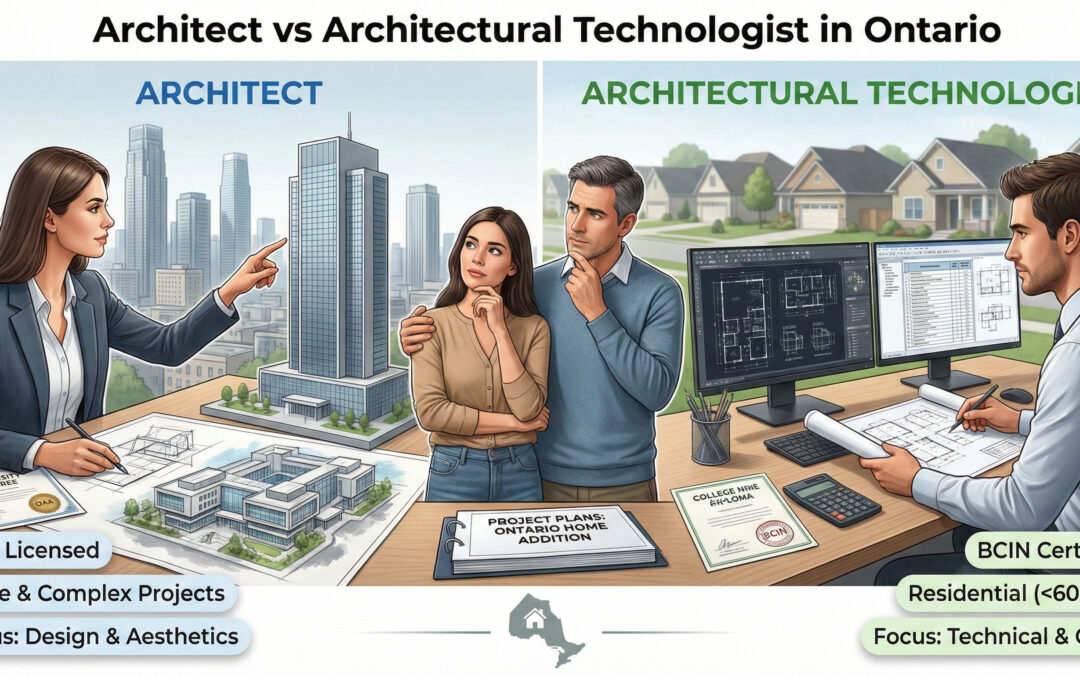
Architect vs Architectural Technologist in Ontario: Who Do You Need for Your Project?
Planning a renovation, home addition, or custom build in Ontario? One of the first decisions you’ll face is choosing between an architect and an architectural technologist. Both professionals can create building plans and help you obtain permits, but they have different qualifications, capabilities, and costs.
This guide explains the key differences between architects and architectural technologists in Ontario, including education requirements, project limitations, and when you need each professional for your building project.
Table of Contents
- Key Differences at a Glance
- What Is an Architect?
- What Is an Architectural Technologist?
- What Is a BCIN Number?
- Project Limitations in Ontario
- Cost Comparison
- When You Need an Architect
- When a Technologist Is Sufficient
- Frequently Asked Questions
Key Differences at a Glance
| Criteria | Architect | Architectural Technologist |
|---|---|---|
| Education | Bachelor’s + Master’s degree in Architecture (5-7 years) | College diploma (2-3 years) |
| Licensing | Licensed by OAA (Ontario Association of Architects) | BCIN certification from MMAH |
| Residential Limit | No size restrictions | Houses under 600 m² (6,458 sq ft) |
| Commercial Work | All building types | Small buildings only (with restrictions) |
| BCIN Required? | No (exempt) | Yes |
| Typical Cost | 8-15% of construction cost | 5-10% of construction cost |
What Is an Architect?
An architect is a licensed professional who has completed extensive education and training in building design. In Ontario, architects must:
- Complete a Bachelor’s degree in Architecture (typically 4 years)
- Complete a Master’s degree in Architecture (additional 2-3 years)
- Graduate from a program accredited by the Canadian Architectural Certification Board (CACB)
- Complete 3,720 hours of internship experience under a licensed architect
- Pass the Examination for Architects in Canada (ExAC)
- Register with the Ontario Association of Architects (OAA)
Architects are trained in both the artistic and technical aspects of building design. They focus on aesthetics, spatial design, building functionality, and how structures fit within their environment and community context.
What Architects Can Do
- Design buildings of any size or complexity
- Work on commercial, institutional, and residential projects
- Design schools, hospitals, churches, and assembly buildings
- Provide full project management from concept to completion
- Sign and seal drawings without BCIN certification
What Is an Architectural Technologist?
An architectural technologist specializes in the technical and practical aspects of building design. In Ontario, technologists typically:
- Complete a 2-3 year college diploma in Architectural Technology
- Obtain BCIN certification from the Ministry of Municipal Affairs and Housing
- May join the Association of Architectural Technologists of Ontario (AATO)
- Focus on construction documentation, building codes, and technical drawings
Architectural technologists are experts at translating design concepts into detailed construction documents. They have in-depth knowledge of the Ontario Building Code, construction methods, and permit requirements.
What Architectural Technologists Can Do
- Design residential homes (with size limitations)
- Prepare permit drawings and construction documents
- Perform building code analysis
- Create CAD drawings and 3D models
- Coordinate with engineers and contractors
- Submit drawings for building permit approval
What Is a BCIN Number?
The Building Code Identification Number (BCIN) is a license issued by Ontario’s Ministry of Municipal Affairs and Housing (MMAH) that certifies a designer’s knowledge of the Ontario Building Code.
Key Facts About BCIN
- Required for: Architectural technologists, technicians, and designers submitting permit drawings in Ontario
- Exempt: Licensed architects and professional engineers
- Qualifications: Multiple categories including House, Small Buildings, Large Buildings, Plumbing, and Septic
- Renewal: Annual renewal required with proof of insurance
To obtain a BCIN, designers must pass exams administered by the MMAH. The General Legal exam is mandatory, followed by qualification-specific exams based on the type of work they want to perform.
Learn more about BCIN requirements and our qualified team.
Project Limitations in Ontario
The Ontario Architects Act defines what types of buildings each professional can design:
What BCIN Designers/Technologists CAN Design
- Single-family homes and duplexes (no area limit if not stacked)
- Townhouses up to 3 storeys and 600 m² (6,458 sq ft)
- Small commercial buildings up to 600 m²
- Residential additions and renovations
- Detached garages, decks, and accessory structures
- Basement apartments and secondary suites
What ONLY Architects Can Design
- Buildings over 600 m² (6,458 sq ft)
- Buildings over 3 storeys
- Assembly occupancies: Churches, restaurants (over 30 persons), reception halls, theatres
- Institutional buildings: Schools, hospitals, nursing homes
- Care facilities: Daycares, retirement homes
- Multi-unit residential buildings (stacked units)
Cost Comparison
| Service | Architect | Architectural Technologist |
|---|---|---|
| Custom home design (2,500 sq ft) | $20,000 – $50,000 | $8,000 – $20,000 |
| Home addition drawings | $5,000 – $15,000 | $2,000 – $6,000 |
| Renovation permit drawings | $3,000 – $8,000 | $1,500 – $4,000 |
| Hourly consultation rate | $150 – $300/hour | $75 – $150/hour |
Note: Costs vary based on project complexity, location, and individual firm pricing. Always request detailed quotes from multiple professionals.
When You Need an Architect
You must hire an architect for your Ontario project if:
- Your building exceeds 600 m² (6,458 sq ft)
- Your building is more than 3 storeys
- You’re building a restaurant, church, school, or hospital
- Your project involves care or assembly occupancies
- You’re building a multi-unit residential building with stacked units
You may want to hire an architect even when not required if:
- You want innovative, custom architectural design
- Your project has complex site conditions or unusual requirements
- You’re building a high-end luxury home
- You need full project management services
- The design aesthetic is your top priority
When an Architectural Technologist Is Sufficient
An architectural technologist is typically the right choice for:
- Standard residential projects: Custom homes, additions, renovations
- Permit drawings: Permit documentation for straightforward projects
- Budget-conscious projects: When cost savings matter
- Code-focused work: Projects requiring deep building code expertise
- Secondary suites: Basement apartments and in-law suites
- Accessory structures: Garages, decks, sheds
Most residential renovation and new home projects in Ottawa fall within the scope of what an architectural technologist can legally design, making them an excellent choice for homeowners seeking professional drawings at a lower cost.
Our team includes both architects and architectural technologists to serve projects of all sizes.
Frequently Asked Questions
What is the difference between an architect and architectural technologist in Ontario?
Architects have university degrees (5-7 years), are licensed by the OAA, and can design any building type without restrictions. Architectural technologists have college diplomas (2-3 years), require BCIN certification, and are limited to residential projects under 600 m² and small commercial buildings. Technologists focus on technical documentation while architects emphasize design aesthetics.
Do I need an architect to build a house in Ontario?
No, you don’t need an architect for most residential homes in Ontario. A BCIN-certified architectural technologist can design single-family homes, duplexes, and townhouses up to 600 m² (6,458 sq ft) and 3 storeys. You only need an architect if your home exceeds these limits or includes assembly/care occupancies.
What is a BCIN number in Ontario?
A Building Code Identification Number (BCIN) is a license from Ontario’s Ministry of Municipal Affairs and Housing certifying that a designer has passed exams on the Ontario Building Code. It’s required for architectural technologists, technicians, and designers to submit permit drawings. Architects and engineers are exempt from BCIN requirements.
Is an architectural technologist cheaper than an architect?
Yes, architectural technologists typically charge 30-50% less than architects for comparable services. While architects may charge 8-15% of construction costs, technologists often charge 5-10%. For a standard home renovation or addition, this can mean savings of several thousand dollars while still receiving professional, code-compliant drawings.
Can an architectural technologist stamp drawings in Ontario?
Yes, BCIN-certified architectural technologists can sign and submit drawings for building permits within their qualification scope. Their drawings include their BCIN number, which validates their authority to submit plans. However, some projects may require additional stamps from structural engineers or other specialists.
What projects require an architect in Ontario?
You need an architect in Ontario for buildings over 600 m² or 3 storeys, assembly occupancies (churches, restaurants over 30 persons, theatres), institutional buildings (schools, hospitals), care facilities (daycares, nursing homes), and multi-unit residential with stacked dwelling units.
Need Professional Architectural Services in Ottawa?
At Architectural Drawing, our team includes both architects and BCIN-certified architectural technologists. We match you with the right professional for your project scope and budget.
We provide:
- Custom home design
- Home addition plans
- Permit drawings
- Basement renovation plans
- Building permit application support
Contact us for a free consultation:
Phone: (613) 518-1387
Note: All prices mentioned in this article are provided for general reference and informational purposes only. These prices are not fixed and may vary depending on facts, market conditions, location, time, availability, or other relevant factors. Actual prices may change without prior notice. Readers are advised to verify details independently before making any decisions.